01 Blisters & Hot Spots Fix guide
Hiking Boot Lacing Techniques for Heel Slip, Wide Feet and Downhill Toes
Most boot-fit complaints are lacing problems in disguise. Here's a pattern for each one, and when a different lace hardware setup does more of the work.
- By
- Mike M.
- Updated
- Method
- How we choose
We earn a commission if you buy through our links, at no extra cost to you. It never decides the ranking: the method is published. Affiliate disclosure
Start with even tension
Before you apply any of the patterns below, lace the boot from the toe up with even, moderate tension at every eyelet rather than cinching the whole boot tight in one pull. A boot that's crushingly tight from the toe up won't hold any better than one laced loosely, and it adds pressure points of its own across the top of the foot. Get a comfortable, even base first, then adjust at the specific spot that's giving you trouble.
Heel-lock, for a slipping heel
If your heel lifts out of the heel cup on every step, lace normally up to the second-to-last pair of eyelets or hooks, then at that pair feed the lace back through the same eyelet instead of crossing it, so you get a small loop on each side. Cross the two loops over each other and pull them snug before finishing the rest of the lacing. That locks tension at your ankle instead of letting it pull loose at the top. For the full breakdown of why heels slip in the first place, see heel slipping in hiking boots.
Lacing for wide feet
If the forefoot pinches but the ankle fits fine, skip a set of eyelets across the widest part of your foot instead of crossing the laces there, then resume normal crossed lacing above it. This takes pressure off the widest part of the forefoot without loosening the ankle hold. If skipped lacing still isn't enough room, that's a sign to check a wide or extra-wide width rather than keep loosening the laces, covered in best hiking boots for wide feet.
Lacing for downhill toe relief
On descents, your foot slides forward inside the boot with every step, and if the forefoot lacing is loose, your toes jam repeatedly into the front of the boot. That repeated impact is what causes the bruised, black toenails hikers call runner's toe. Cleveland Clinic notes that "running downhill naturally pushes your toes forward in your shoes" and specifically recommends you "retie laces to improve fit and reduce movement" as one of the practical fixes (Cleveland Clinic: Runner's Toe, accessed Sep 2026). Before a downhill stretch, snug the lacing across the forefoot and instep more than you would on flat ground, then finish with a heel-lock at the top so your whole foot is held back from the front of the boot. For more on the toenail issue itself, see why your toes hurt hiking downhill.
Lacing for top-of-foot pain
If the ache is across the top of your foot rather than at the heel or toes, the laces are usually just too tight over a high instep or a prominent tendon. Skip the eyelet directly over the sore spot, or lace it loosely by running the lace along the outside rather than straight across, then re-tighten above and below it. This is a lacing fix first, not a sizing problem; see why your hiking boots hurt your feet for the rest of that picture if it doesn't resolve.
Whatever pattern you use, friction under an uneven or loose lace is still friction, and the NHS lists "wearing comfortable, properly-fitted footwear" as one of its main ways to avoid blisters in the first place (NHS: Blisters, accessed Sep 2026). A pattern that holds without pinching beats one that's just pulled tighter everywhere.
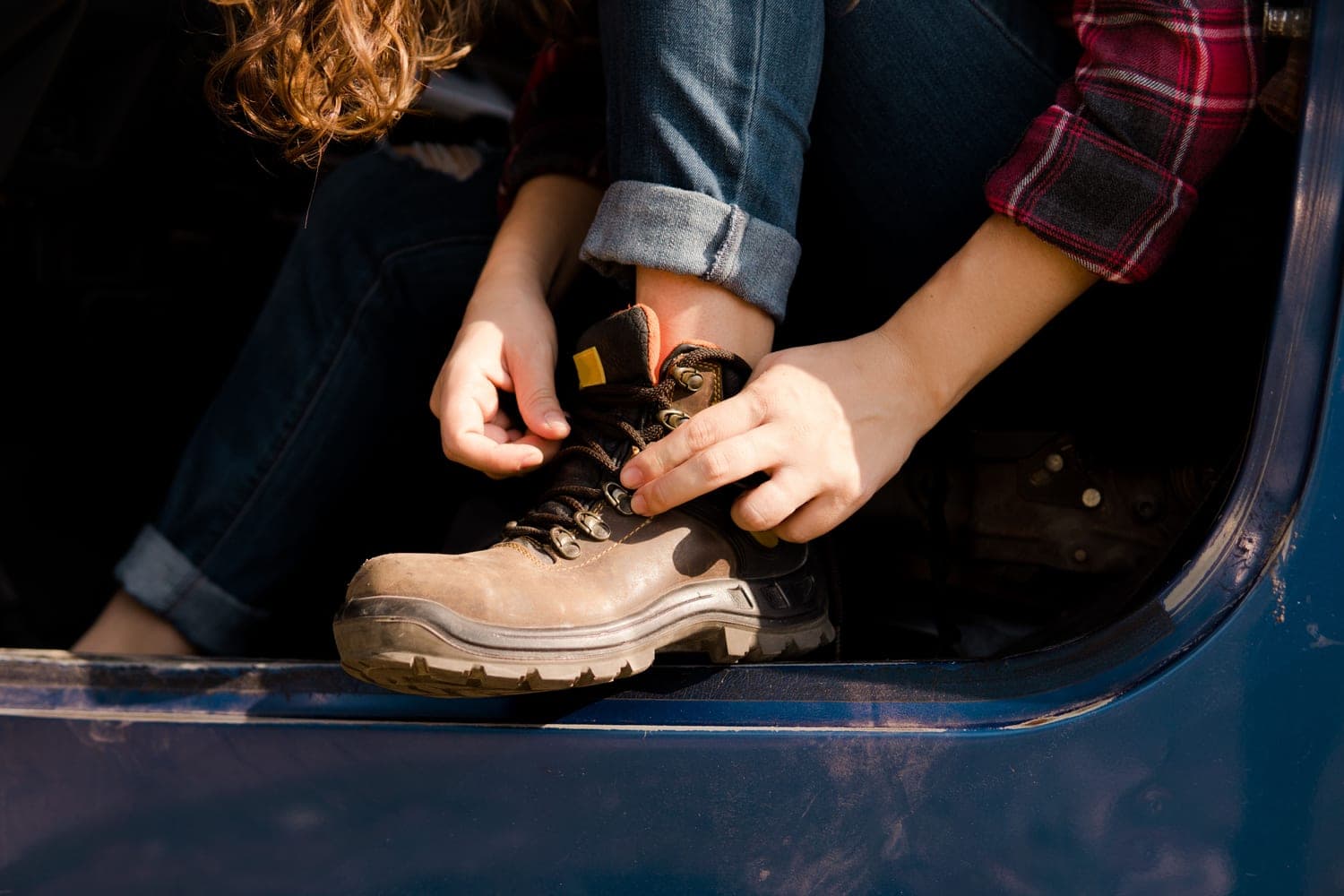
If you'd rather not fuss with laces at all on quick trips, that quickLACE-style trade-off is worth knowing about before you buy: fast and even, but less adjustable point-to-point than a traditional hook lacing boot like the one above.
Worn-out laces undo all of this
None of these patterns hold if the laces themselves are the problem. Laces that have stretched out over a season, or that are too slick to grip a knot, work themselves loose no matter how you tie them, which is how a heel-lock that held fine in the store starts slipping a few miles into a hike. Round, waxed laces tend to hold a knot better in wet conditions than flat cotton ones. If you're re-tying mid-hike more than once or twice, it's worth replacing the laces before you assume the pattern itself has failed.
How we chose
Units we claim to have tested: 0
Everyone in this category says they tested it. We didn't, and we say so. Every pick is scored from the brand's published specs, width and size charts, warranty terms and cited research, against the problem this page is about. The sources are listed at the bottom of the page.
Scores are editorial judgments from that published data, not lab results. Nobody pays for placement, and a missing spec is scored neutral, never guessed. The full rubric is on How We Choose.
- Problem fit
- 30%
- Fit range
- 25%
- Support & protection
- 20%
- Durability & warranty
- 15%
- Weight
- 10%
The weights this page used for its scores.
FAQ
Questions people ask
How do you heel lock lace hiking boots?
How do I lace hiking boots for wide feet?
How do I stop my toes hitting the front of my boots going downhill?
Does lacing affect ankle support?
What's the difference between lace hooks and eyelets?
Should I re-lace before a long descent?
Keep going
Related fixes and picks
- Heel slipping in hiking bootsThe full cause-and-fix breakdown behind the heel-lock pattern.
- Toes hurt hiking downhillWhy downhill toe jam happens and the fixes beyond lacing.
- Why do my hiking boots hurtTop-of-foot, ankle bone and Achilles pain that lacing alone doesn't fix.
- Best hiking boots for wide feetWhen a wider width beats lacing around a tight forefoot.
Update log
What changed
- First published.
Receipts
Sources
- 01Cleveland Clinic: Runner's Toe (accessed Sep 2026)
- 02NHS: Blisters (accessed Sep 2026)
- 03Columbia: Newton Ridge Plus II Waterproof product page (accessed Sep 2026)
- 04Zappos: Salomon X Ultra 5 Mid Wide GTX product page (accessed Sep 2026)
We don't test boots, shoes or gear, and we don't pretend to. Specs, widths and materials come from the brand's own pages (or a named retailer's listing where the brand doesn't publish them); health information comes from the research and professional bodies linked above. Prices are set by Amazon and change often, so we don't print them. Where a figure isn't published, we say so. Read the full method.