02 Rolled Ankles & Ankle Support Fix guide
Do Hiking Boots Prevent Ankle Sprains?
A taller cuff feels safer, but the evidence on high-cut boots is mixed. Here's what the research says, and what actually cuts your risk on the trail.
- By
- Mike M.
- Updated
- Method
- How we choose
We earn a commission if you buy through our links, at no extra cost to you. It never decides the ranking: the method is published. Affiliate disclosure
What actually causes a rolled ankle
A rolled ankle is almost always the same injury: your foot twists so the sole turns inward while your ankle rolls outward, stretching or tearing the ligaments on the outside of the joint. The American Academy of Orthopaedic Surgeons (AAOS) lists the usual triggers as walking on an uneven surface, falling, tripping, or landing awkwardly, and it names several things that raise your odds of it happening: poor balance, ligaments that are already loose or flexible, poor ankle alignment, shoes that don't provide enough support, and shoes with slippery soles.
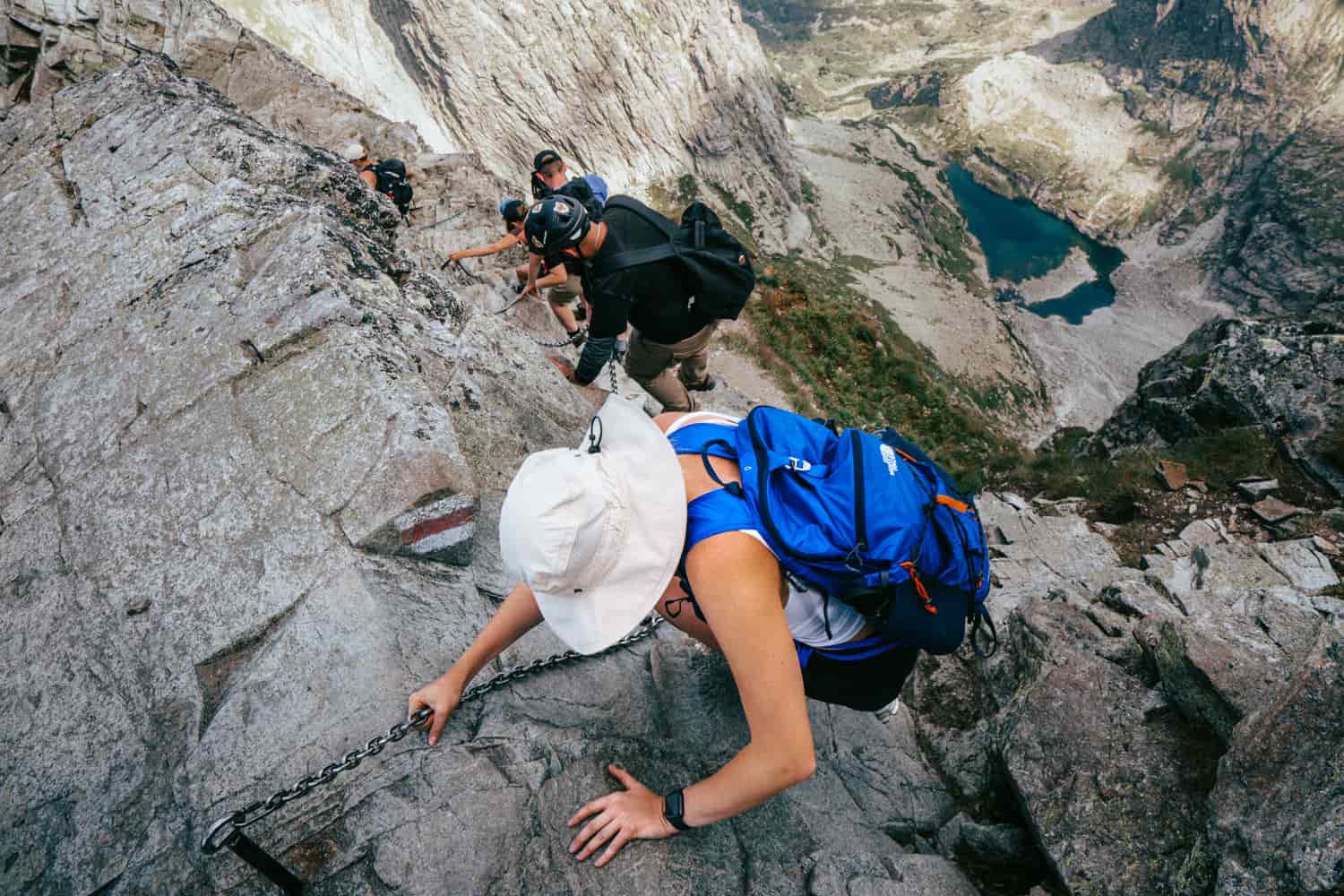
On a trail, that translates directly: loose rock, roots, camber on a sidehill, and tired legs late in a long day all raise the odds of a bad step. A loaded pack changes things too. It shifts your center of gravity higher and further back, so the same misstep asks more of your ankle to recover from. None of that is unique to footwear, which is why the AAOS also lists a previous sprain as one of the biggest risk factors for the next one: once a ligament has been stretched, the ankle tends to give out more easily.
"Rolling" an ankle is almost always the same specific injury. Per the AAOS, about 90% of ankle sprains are an inversion injury, where the foot turns inward and stretches or tears the anterior talofibular (ATFL) and calcaneofibular (CFL) ligaments on the outside of the ankle. The less common version is an eversion injury to the deltoid ligament on the inner side of the ankle. The AAOS grades severity in three steps: Grade 1 is slight stretching and microscopic tearing with no real instability; Grade 2 is a partial tear with moderate swelling and slight instability; Grade 3 is a complete tear with significant swelling, bruising and instability. Recovery reflects that range: the AAOS notes a standard three-phase treatment program can take as little as 2 weeks for a minor sprain or 6 to 12 weeks for a more severe one, which is worth knowing before you decide whether a sore ankle is a rest day or a reason to see a doctor.
What the research says about high-cut boots
The honest answer is that the evidence doesn't clearly back up the assumption that a taller boot stops a sprain. Cleveland Clinic's summary of the research on high-top shoes and ankle support calls the findings contradictory: some studies show a high-top design reduces how far the foot rolls inward, but others find that a high-top "did not prevent excessive inversion" once someone is actually moving, jumping or landing. The orthopedic surgeon quoted on that page puts the bigger factor plainly: what actually stops an ankle from rolling too far is fast activation of the muscles on the outside of your lower leg, the ones that evert the foot back upright. Her caution is worth repeating, because it cuts against the instinct to just buy a taller boot: a high-cut upper can make those muscles fire later and less effectively, because the boot is doing some of the stabilizing work the muscle would otherwise do itself.
There's a reason high-cut construction is still standard advice in some sports. The American Podiatric Medical Association's guide to choosing sport shoes recommends "high ankle construction that supports the ankle during quick changes in direction" for basketball, and calls for "a good amount of high ankle support" in football and lacrosse, sports built around sudden cuts and pivots on a flat court or field. Hiking is a different movement pattern: mostly forward travel over an uneven, unpredictable surface, often for hours at a time, sometimes under load. That doesn't mean the reasoning transfers one-for-one, and no source we cite here studied hikers specifically. What it does mean is that boot height is one input among several, not a substitute for the others.
There's a practical implication worth sitting with. If Cleveland Clinic is right that a high cuff can make your own stabilizing muscles activate later, then leaning on a tall boot as your only defense, and skipping the balance and strength work below, could leave you worse prepared for the one time the boot doesn't catch it. That's not a reason to avoid supportive boots. It's a reason to treat them as one part of the plan rather than the whole plan, especially if you've had ankle trouble before and are tempted to buy your way past it.
What actually helps, try this first
Before you shop for a taller boot, the free fixes are worth doing anyway, because they address the parts of the AAOS risk list that footwear alone can't touch.
Trekking poles help too, simply by giving you two more points of contact when the ground under one foot turns out to be less stable than it looked. On a steep, loose descent, that extra contact can catch a stumble before your ankle has to.
How pack weight changes the calculation
A day pack and a loaded backpacking pack put very different demands on the same ankle. Extra weight sits above your center of gravity, so when a foot lands wrong, there's more mass moving before your ankle and the surrounding muscles can arrest it. That's a mechanical reality of carrying load, separate from anything cuff height changes. A well-fitted hip belt that transfers weight off your shoulders and onto your hips also keeps you more upright and less likely to lurch when you catch an edge wrong, which is as much about pack fit as about boots. Where footwear does plausibly matter more under load is torsional stiffness: a soft, flexible shoe lets the whole foot twist more freely on an angled rock, while a stiffer sole and a supportive midsole resist that twist before it reaches the ankle joint. That's a mechanical argument about how the boot behaves underfoot, not a claim that it prevents an injury outright.
When a mid or high boot makes sense
Given the mixed evidence, choose boot height for the conditions, not as insurance. A mid or high boot earns its weight in a few specific situations: carrying a heavy pack, where the extra load raises the stakes of any misstep; loose, rocky or technical terrain, where the odds of a bad step go up; and a history of ankle sprains, since the AAOS notes a previous sprain raises the risk of the next one. If none of those apply, a low-cut shoe or trail runner isn't automatically riskier, so it's worth reading how to choose between boots and trail runners by terrain and pack weight rather than assuming taller is always safer.
Whatever height you land on, shop for the features that plausibly help rather than the cuff alone: a named chassis or shank rather than just "mid" in the name, a heel counter and lacing that actually locks your heel down, and an outsole with a compound and lug pattern suited to the ground you actually hike. A tall boot with none of those is mostly extra weight; a low-cut shoe with a stated stability feature can do more for you than its height suggests.
If you do want the extra support, see our ranked best hiking boots for ankle support, or, for loose rock and technical ground specifically, best hiking boots for rocky terrain. And if you're trying to decide between a mid-cut and a low-cut version of the same boot, mid vs low hiking shoes lays out the trade-off directly.
If you keep rolling the same ankle
A boot change won't fix a joint that keeps giving out. The AAOS is direct about this: once you've sprained an ankle, you're more likely to sprain it again, and repeat sprains are usually a sign that the ligaments never fully regained their strength or that the muscles around the joint aren't reacting fast enough. The AAFP notes that after a sprain, a doctor may have you wear a brace or air cast for several weeks while you walk, on top of the balance and strengthening exercises above. If your ankle is still unstable weeks after an injury, or you're rolling it on flat, unremarkable ground, that's worth a visit to a doctor or physical therapist rather than a new pair of boots. For what to do in the moment on a trail, see what to do for a rolled ankle while hiking.
Put all of this together and the honest version is less satisfying than a marketing claim, but more useful: no boot, mid or high, guarantees you won't roll an ankle. What consistently shows up across the sources above is that footing, fatigue, fit, and how quickly your own ankle reacts matter as much as, or more than, how tall the boot is. Do the free fixes first, buy the extra support when the terrain or the load actually calls for it, and treat a boot as one part of staying upright rather than the whole plan.
How we chose
Units we claim to have tested: 0
Everyone in this category says they tested it. We didn't, and we say so. Every pick is scored from the brand's published specs, width and size charts, warranty terms and cited research, against the problem this page is about. The sources are listed at the bottom of the page.
Scores are editorial judgments from that published data, not lab results. Nobody pays for placement, and a missing spec is scored neutral, never guessed. The full rubric is on How We Choose.
- Problem fit
- 30%
- Fit range
- 25%
- Support & protection
- 20%
- Durability & warranty
- 15%
- Weight
- 10%
The weights this page used for its scores.
FAQ
Questions people ask
Do hiking boots protect ankles?
Are mid or low hiking shoes better for a bad ankle?
Do trail runners cause more rolled ankles than hiking boots?
What actually stops you from rolling your ankle on the trail?
Should I buy a taller boot after spraining my ankle?
Do high-top shoes really support the ankle in any sport?
What are the biggest risk factors for spraining an ankle while hiking?
How long does a rolled ankle take to heal?
Keep going
Related fixes and picks
- Best hiking boots for ankle supportRanked mid and high boots for hikers who want extra stability.
- Mid vs low hiking shoesThe same boot in both cuts, compared directly.
- What to do for a rolled ankle while hikingCited first-aid steps for the trail.
- Hiking boots vs trail runnersHow terrain, pack weight and ankle history decide it.
Update log
What changed
- First published.
Receipts
Sources
- 01AAOS OrthoInfo: Sprained Ankle (accessed Sep 2026)
- 02Cleveland Clinic: What's the Best Way to Support Your Ankles During Exercise? (accessed Sep 2026)
- 03APMA: Sprains, Strains, and Fractures (accessed Sep 2026)
- 04APMA: Choosing Shoes for Sports (accessed Sep 2026)
- 05AAFP: How to Care for Your Ankle Sprain (accessed Sep 2026)
We don't test boots, shoes or gear, and we don't pretend to. Specs, widths and materials come from the brand's own pages (or a named retailer's listing where the brand doesn't publish them); health information comes from the research and professional bodies linked above. Prices are set by Amazon and change often, so we don't print them. Where a figure isn't published, we say so. Read the full method.